
Do Air Purifiers Help With Dust Allergies? (India, 2026)
Air purifiers help with dust allergies, but only with the part of "dust" that floats. A HEPA-13 purifier pulls airborne dust, pollen, pet dander and smoke out of the air you breathe — the triggers that set off sneezing, a runny nose and itchy eyes. What it cannot touch is the dust mite living deep in your mattress and pillow, and for most Indian homes the mite is the bigger allergy driver. So the honest answer is: a purifier is half the fix. Get both halves right and the difference is real; buy only the machine and you will still wake up congested.
This guide explains what an air purifier actually removes, why HEPA-13 is the spec that matters, the room-size and filter numbers to check before you pay, and the bedding routine that does the other half of the job.
What causes dust allergy in an Indian home?
Two very different things get lumped together as "dust."
The first is airborne particulate — fine road dust that blows in through windows, construction PM, pollen in spring, pet dander, cooking smoke and agarbatti smoke. These particles stay suspended in the air for minutes to hours, which is exactly why a purifier can catch them: the fan pulls room air through the filter faster than the particles settle.
The second is the house dust mite — a microscopic creature that lives in mattresses, pillows, sofas and thick curtains, feeding on shed skin. Its droppings are the classic year-round allergen behind morning sneezing and blocked noses. Mites and their waste are heavy; they sit in fabric, not in the air, so a purifier running in the corner never meets them.
Knowing which trigger is yours changes the answer. Sneezing worst when you make the bed or vacuum? That is mites — bedding work matters most. Symptoms that track with outdoor air, pets or cooking smoke? That is airborne, and a purifier earns its price.
Do air purifiers remove dust from the air? Yes — if the filter is HEPA-13
A true HEPA filter is defined by how much it captures at the hardest particle size to catch, 0.3 microns. HEPA-13 removes 99.97% of particles at 0.3 microns, including the fine dust, pollen and dander that trigger allergic rhinitis. Lower grades — the "HEPA-type" or H11 filters common on cheap units — let noticeably more through, and the marketing rarely says so.
So the single spec that decides whether a purifier helps your allergy is the filter grade. Look for the words HEPA-13 (or H13), a real pleated filter, and ideally a pre-filter plus activated carbon layer in front of it to trap larger dust and odours so the HEPA lasts longer.
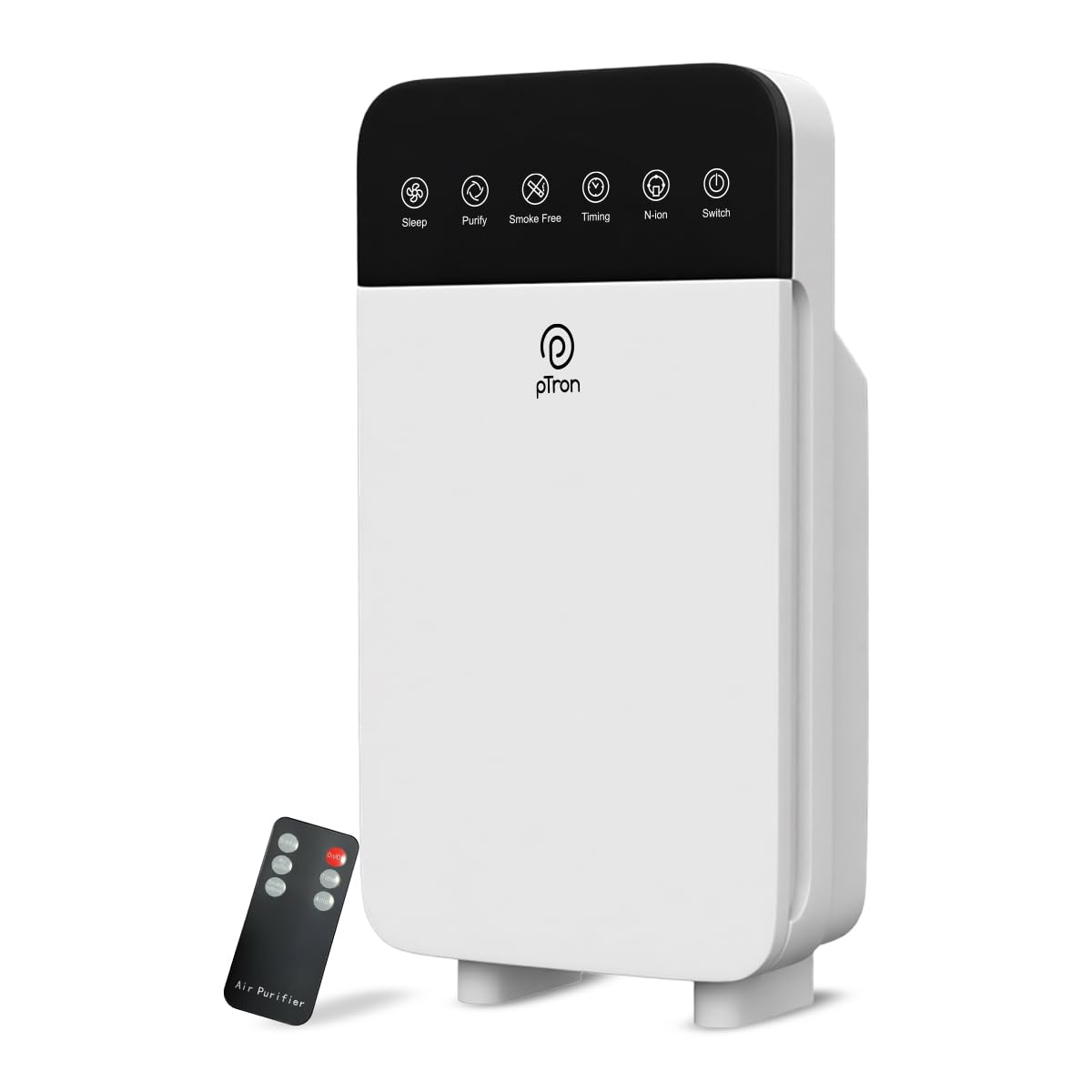
A HEPA-13, activated-carbon unit sized for a bedroom is the sweet spot for most allergy sufferers. The pTron EaseMate Air Purifier H1 is a live example — 4-stage filtration with an H13 filter and carbon layer, priced for a single room — and it shows the feature set to compare against rather than a spec to take on faith. For a wider set of options across room sizes and budgets, see our best air purifiers in India roundup.
The two numbers that matter more than the brand
Ignore the star ratings for a moment. Two figures tell you whether a purifier will actually clear your room.
- CADR (Clean Air Delivery Rate) — how much clean air the unit pushes per hour, in m³/h. Higher is faster. Match it to your room: a small bedroom (up to ~150 sq ft) is fine with a modest CADR; a hall needs a much bigger unit or it will run flat out and never catch up.
- ACH (Air Changes per Hour) — how many times the machine filters the room's full air volume each hour. For allergy relief you want 4–5 ACH, i.e. the air is cleaned roughly every 12–15 minutes. A purifier rated for a room twice your size will hit that easily on a quieter, lower fan speed — which is why buying slightly oversized is smarter than buying to the exact limit.
If the box only quotes "coverage area" with no CADR, treat that number as optimistic and size down your expectations by a third.
Where to place it, and how to run it
Placement changes the result more than people expect.
Put the purifier in the room you spend most sleeping hours in — the bedroom, not the living room — because that is where allergy symptoms build overnight. Keep it off the floor and away from walls and furniture so air can reach the intake from all sides; a unit jammed in a corner recirculates the same pocket of air.
Run it continuously on a low-to-medium speed rather than blasting it for an hour a day. Steady low-speed running holds the particle count down around the clock and is far quieter, which matters if it lives beside your bed. Close windows while it runs; an open window feeds new dust faster than the fan can clear it.
The other half: the dust-mite routine a purifier can't do
Because mites live in fabric, this part is not optional if morning congestion is your main symptom:
- Wash bedding weekly in hot water (60°C / 140°F). Warm or cold water leaves mites alive; the heat is the point.
- Use allergen-proof (dust-mite) covers on the mattress and pillows — a tightly woven barrier the mite cannot get through.
- Swap heavy curtains and thick rugs in the bedroom for washable ones, and cut clutter that collects dust.
- Vacuum with a HEPA-filter vacuum, ideally when the allergic person is out of the room, since vacuuming briefly kicks dust into the air (the purifier then mops that up).
- Keep indoor humidity moderate. Mites thrive in humid air; a drier bedroom slows them down.
Do these alongside the purifier and you cover both the airborne and the settled triggers. That combination — not the machine alone — is what actually changes how you feel in the morning.
So is an air purifier worth it for allergies?
Yes, with a clear expectation. If your triggers are airborne — pollen, pet dander, road dust, smoke — a HEPA-13 purifier sized to your bedroom gives fast, noticeable relief, and it is the single best indoor-air upgrade you can make. If your trigger is dust mites, the purifier is a genuine help but a supporting one; the hot-wash-and-cover routine does the heavy lifting.
Buy the purifier for the filter grade and the CADR, not the badge, run it in the bedroom around the clock, and pair it with the bedding routine. For current HEPA-13 models and prices across budgets, browse our live air-purifier deals and daily offers.
Quick answers
Does a HEPA air purifier help with dust allergy? Yes — a HEPA-13 filter captures 99.97% of airborne dust, pollen and dander at 0.3 microns, which relieves the sneezing and congestion those particles cause. It does not remove dust mites living in bedding, so pair it with weekly hot-water washing.
Where should I keep an air purifier for allergies? In the bedroom, raised off the floor and away from walls, running continuously on low-to-medium speed with the windows closed. That is where overnight symptoms build, so that is where the machine pays off.
Will an air purifier stop my morning sneezing? Only partly if the cause is dust mites in your mattress and pillows, since those aren't airborne. Combine the purifier with allergen-proof bedding covers and a 60°C wash to address both the air and the fabric.
Ready to save?
Browse today's handpicked deals — verified prices, updated every few minutes.
See Live DealsKeep reading
 Guide
GuideBest Air Fryer Under ₹6000 in India (2026): Real Prices, Real Picks
Ten in-stock air fryers under ₹6,000, picked by use-case with live prices — best overall, best budget, best for a family of four, and the three specs that actually decide value.
 Deals
DealsBest Power Bank Under ₹1,500 in India (2026): Live Deals
₹1,500 is the sweet spot for power banks in 2026. Here's 10,000 vs 20,000mAh, the specs that matter, the 2026 airline rules — plus live deals from ₹849.
 Deals
DealsBest Air Purifiers in India 2026: Buying Guide & Deals
A practical 2026 guide to buying the right air purifier in India: what HEPA grade and CADR your room needs, real running costs, which filters matter, and when to buy for the lowest price before pollution season peaks.