
2.1 vs 3.1 vs 5.1 Soundbar: What the Channel Numbers Mean and Which to Buy
For most Indian living rooms, a 2.1 soundbar (bar plus subwoofer) is the right buy: it fixes thin TV sound and adds real bass for the least money. Pick a 3.1 if you mainly watch dialogue-heavy shows and films and keep missing lines, because the extra centre channel is built for voices. Go 5.1 only if you have space for two rear speakers beside or behind the sofa and will run their cables or pay for wireless rears. The channel number tells you how many separate speaker groups play sound, not how loud or how good the soundbar is.
This guide decodes every number on a soundbar box, matches each to a room, and covers the connection mistakes that make a 5.1 system play like a 2.0. Verified soundbar prices are on our live offers page.
What the soundbar channel numbers mean
A channel is a separate stream of audio sent to its own speaker or group of drivers. The label has up to three parts:
- First number: main channels at ear level (left, right, centre, rear left, rear right).
- Second number (.1 or .2): subwoofers, the low-frequency bass channel.
- Third number (.2 or .4), if present: height channels, speakers that fire upward for Dolby Atmos.
| Label | What you get | Speaker boxes |
|---|---|---|
| 2.0 | Left + right, no subwoofer | 1 bar |
| 2.1 | Left + right + 1 subwoofer | Bar + sub |
| 2.2 | Left + right + 2 bass drivers | Usually 1 bar with bass drivers built in |
| 3.1 | Left + centre + right + 1 subwoofer | Bar + sub |
| 5.1 | Left + centre + right + 2 rears + 1 subwoofer | Bar + sub + 2 rear speakers |
| 5.1.2 | 5.1 plus 2 upward-firing height channels | Bar + sub + 2 rears, with up-firing drivers |
What does 2.2 mean on a soundbar?
2.2 sounds like an upgrade over 2.1, but on budget models it usually means two woofers or bass drivers built inside the bar, not two separate subwoofer boxes. A small driver inside a slim bar cannot move as much air as a separate sub. For deep bass in a living room, a 2.1 with an external sub generally beats a 2.2 all-in-one at the same price. A 2.2 bar makes sense in a bedroom or on a desk where there is no room for a sub.
2.1 vs 3.1: the centre channel is for dialogue
In films and shows, almost all speech is mixed into the centre channel. A 2.1 soundbar has no centre speaker, so it blends voices into the left and right speakers along with music and effects. A 3.1 soundbar gives voices their own drivers in the middle of the bar.
That matters if you keep raising the volume for dialogue and lowering it when the background score kicks in, or if older family members find TV speech hard to follow. A "voice" EQ mode on a 2.1 bar helps, but it is processing, not a dedicated speaker. If dialogue clarity is your main complaint, 3.1 is the honest fix.
3.1 vs 5.1: are rear speakers worth it?
5.1 adds two rear speakers that sit beside or behind your seating position. When a film is mixed in 5.1, as many OTT films and series are, sounds move around the room: rain, crowd noise, a car passing from front to back.
Rear speakers only work if they are placed right:
- They need to be beside or slightly behind where you sit, at roughly ear height. Rears placed in front of you next to the TV just make a wider 3.1.
- Wired rears, common on budget 5.1 bars, need cable runs around the room. In a rented flat, that is often the deciding factor.
- Wireless rears still need a power socket near each speaker. "Wireless" means no audio cable, not no cable at all.
If your sofa is pushed against the back wall, there is nowhere for rear speakers to go. A good 3.1 will serve you better than a cramped 5.1.
What 5.1.2 and Dolby Atmos add
The ".2" in 5.1.2 means two height channels. Dolby Atmos soundtracks place some sounds above you, such as rain on a roof or a helicopter overhead. Soundbars create this with drivers that fire up at the ceiling so the sound bounces down.
Two conditions decide whether this works:
- Your ceiling: it needs a flat, hard ceiling at a normal height. False ceilings with cut-outs or very high ceilings weaken the effect.
- Your source: you only hear Atmos height effects when the film or show is actually streamed in Atmos and your TV passes it through (see the connection section below).
"Dolby Audio" on a box is not Atmos. It means the bar decodes standard Dolby Digital surround formats.
Which soundbar setup suits your room?
| Your room and use | Best fit | Why |
|---|---|---|
| Bedroom, small TV, light use | 2.0 or 2.2 | No space for a sub; big step up from TV speakers |
| Typical living room, mixed TV, cricket, films | 2.1 | Real bass from a separate sub, best value |
| Lots of dialogue-heavy films and serials | 3.1 | Centre channel keeps voices clear |
| Big living room, space behind the sofa, film nights | 5.1 | Rears give genuine surround |
| Dedicated film corner, flat ceiling, Atmos streams | 5.1.2 or higher | Height effects need the right ceiling and source |
Connect it right or lose the channels
The connection decides how many channels actually reach the bar.
- HDMI ARC: one cable, the TV remote controls volume, and it carries compressed Dolby Digital 5.1. Use the TV's HDMI port marked "ARC". This is the right choice for most buyers.
- HDMI eARC: a newer version that carries higher-bandwidth audio, including lossless formats. It matters for Atmos from a Blu-ray player or games console; check that both the TV and the soundbar list eARC.
- Optical: carries compressed 5.1 but not Atmos, and usually no TV-remote volume control.
- Bluetooth: convenient for phone music, but it is a stereo link with some delay. Do not run a 5.1 bar from the TV over Bluetooth; you get 2-channel sound and possible lip-sync lag.
After connecting, open the TV's sound settings and set the digital audio output to "Auto", "Bitstream" or "Pass-through" rather than "PCM". On many TVs, PCM folds 5.1 down to stereo, so the rear speakers stay quiet.
Ignore the big watt number
Listings lead with figures like 160W, 350W or 600W, but brands measure them differently: some quote RMS (continuous) power, others peak output, and many do not say which. A 160W bar can sound louder than a 300W one. A separate subwoofer, a real centre channel, HDMI ARC and ratings that mention dialogue and bass predict sound quality better than watts.
For more on reading audio spec sheets, see our Bluetooth speaker specs explained guide.
Soundbar deals by channel type
These soundbars are live on RichDeals. Each price was verified on the store page when the deal was posted. Prices move often, so confirm before you pay.
2.0, 2.1 and 2.2: bedrooms and everyday TV
- boAt Aavante Bar 610, 2.0 channel at ₹1,799 (M.R.P. ₹5,990): a compact bar for a bedroom TV.
- Mivi Nex 70, 2.2 channel at ₹2,199 (M.R.P. ₹7,999): bass drivers built into the bar, no separate sub.
- GOVO GoSurround 600, 2.1 channel at ₹2,299 (M.R.P. ₹11,999): a budget bar with a separate 4-inch subwoofer.
- boAt Aavante Orion Plus, 2.1 channel with Dolby Audio at ₹5,999 (M.R.P. ₹21,990): wired subwoofer and Dolby decoding.
- Philips HTL8162, 2.1 channel at ₹7,550 (M.R.P. ₹19,990): a 160W 2.1 setup from Philips.
3.1: clear dialogue
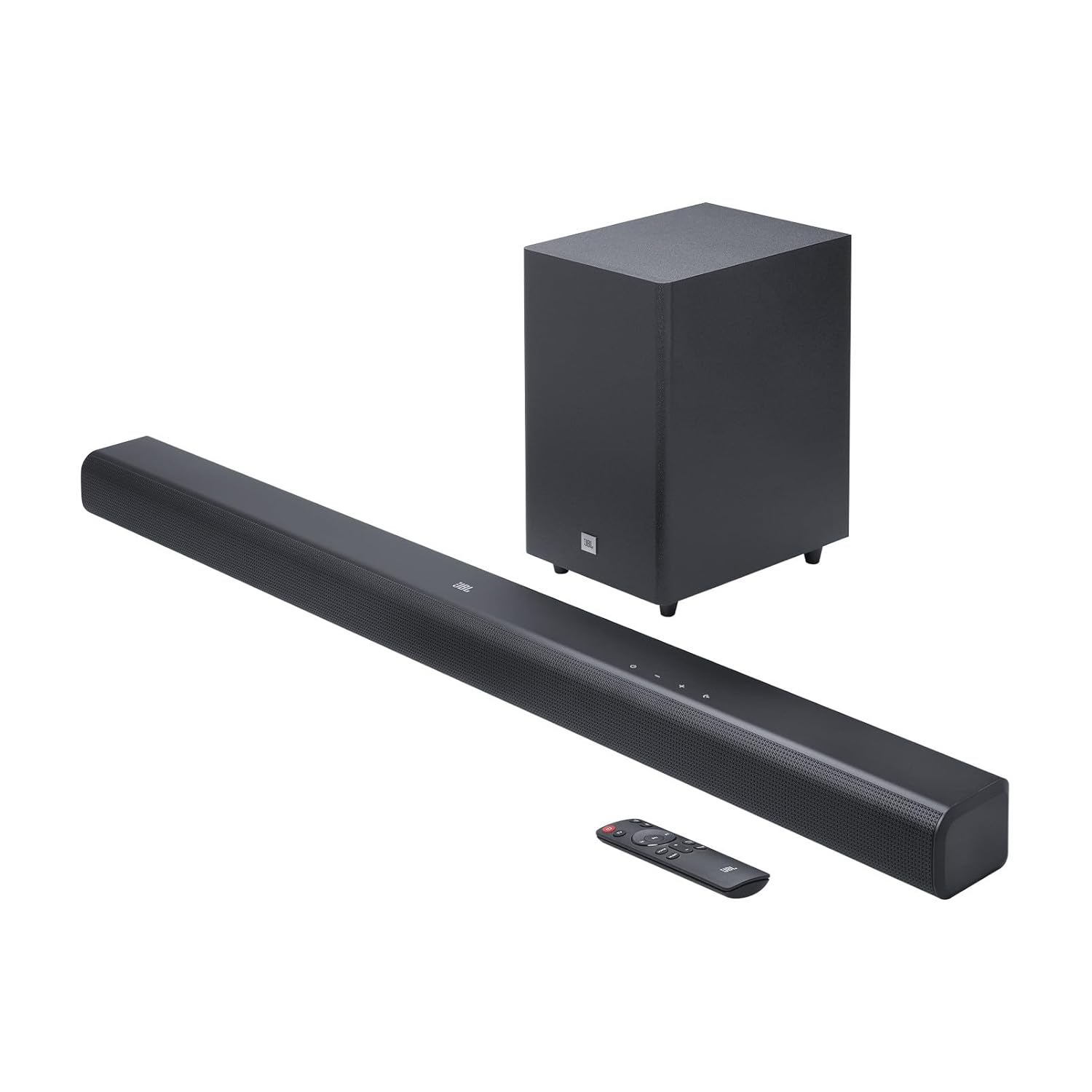
- JBL Cinema SB560, 3.1 channel at ₹10,999 (M.R.P. ₹25,999): a dedicated centre channel, Dolby Audio, and a wireless 5.25-inch subwoofer, so there is no bass cable to run.
5.1 and above: surround sound
- boAt Aavante Bar Prime B160, 5.1 channel at ₹4,999 (M.R.P. ₹23,990): wired subwoofer and wired rear satellites, plus HDMI ARC and Bluetooth 5.3.
- Mivi Fort H350, 5.1 channel at ₹4,999 (M.R.P. ₹34,999) on Flipkart: another entry-level 5.1 package.
- Sony HT-S40R, 5.1 channel at ₹23,989 (M.R.P. ₹34,990): wireless rear speakers, plus HDMI and optical inputs.
- Sony Bravia Theatre System 6 (HT-S60), Dolby Atmos at ₹49,989 (M.R.P. ₹64,990): the step up for Atmos film nights.
Look at the price ladder. On this list the cheapest 5.1 bars cost ₹4,999, less than the boAt 2.1 with Dolby at ₹5,999. At that price the money is spread across more boxes, so read the ratings for bass and dialogue, and be sure you can place the rears properly. For more picks by budget, read our best soundbars under ₹5,000 guide, or browse all current offers.
Frequently asked questions
Is a 5.1 soundbar better than a 2.1?
Only if you can place the rear speakers beside or behind your seat and you watch content mixed in 5.1. Without proper rear placement, a good 2.1 or 3.1 often sounds better for the same money.
Is 2.2 better than 2.1?
Not usually. 2.2 bars typically have bass drivers built into the bar, while 2.1 adds a separate subwoofer box that produces deeper bass.
Do I need HDMI ARC for a soundbar?
For surround sound from the TV, yes. ARC carries 5.1 audio and lets the TV remote control volume; Bluetooth only carries stereo.
Do OTT apps play 5.1 on a soundbar?
Yes, on titles mixed in 5.1, when the TV's audio output is set to pass-through or bitstream and the soundbar is connected over HDMI ARC or optical.
Ready to save?
Browse today's handpicked deals — verified prices, updated every few minutes.
See Live DealsKeep reading
 Comparison
304 vs 202 Stainless Steel Bathroom Fittings: Which One Rusts in India?
304 vs 202 stainless steel for bathroom fittings: what the nickel and manganese numbers mean, why 202 spots, how to check a listing, and when 316 is worth it.
 Comparison
BLDC vs Normal Hair Dryer: Which Should You Buy in India?
How a BLDC hair dryer differs from a regular DC or AC motor dryer, who actually needs one, what to check on the box, and the dryer deals we track from ₹534.
 Comparison
WiFi CCTV vs 4G SIM Camera: Best Home Security Camera Under ₹3,000 in India (2026)
WiFi camera or 4G SIM camera under ₹3,000 — which one actually suits your home, shop, or no-broadband spot in India.